
Emigrant Fictions
A literature of dwelling on it.

A Russian man I’d known in London insisted we go for a drink, now that he lives in New York. We’ve been acquainted for the last decade or so, but had not ever been close, to the extent that it’d be a stretch to describe our relationship even as “friendly,” though I know more about his divorce than I care to. We are to each other stock presences, people who recur in each other’s lives by the sole dint of their shared origins and subsequent migration patterns. He seemed only to have a vague knowledge of the fact that I live here, let alone a sense of why I ended up here or what it is that I do. He declined to go anywhere but the Brooklyn Inn and warned me in advance that he would be arriving on one of those electric skateboards with a single tire.
After regaling me with the tale of his arduous journey towards an American visa (an F-1, he is getting a PhD in math after an illustrious career in project-managing software for fighter drones), which involved being suspected of being a spy and a pleading email to Chuck Schumer. He was incredulous when it turned out that my work schedule didn’t account for President’s Day, and when he was forced to present a physical card instead of his phone to the bartender. “An unbelievable country,” he kept saying as he shook his head. After inquiring what it is that brought me to America, and what it is that keeps me here, he went on to the question that was the purpose of this meeting: which Russian-speaking мероприятия* do I frequent? He was disappointed to hear that not any, really, not anymore, unless uber rides with Ukrainian drivers count or the occasional conversation overheard on the train. “Ok, but are there journalists here?” Yes, I told him, plenty. “So where is the тусовка? Where do the foreign correspondents hang out?” I was stumped. First and 46th? I don’t know, brother, this is New York.
A significant part of my social world when I lived in London: other Russians, often Muscovites, who went to the same five schools. Among them are people whom I have come to love dearly, but I have made it an intention since then not to get drawn into the vortex of a community bound together by little besides language and geography; for some of us, this is why we want to get away from our families, and ending up in Londongrad defeated the purpose. I’ve found, in my years of encountering people whose biographies follow the same beats as mine, that there are schemes of existence into which one can easily fall, the worst and most recognizable of which is the state of perma-expatriatism. I’d say that largely this is an ailment by which I am not afflicted, but because I do have my occasional bouts, I’ll allow myself this: to call this group “rootless cosmopolitans” would not strictly be a dog whistle.
This, of course, is not exclusive to Russians; in fact, I had first come in contact with this type through the Australians and Brits who would move to Moscow to teach English, after stints in Tokyo or Bangkok. In the most egregious cases, there’s a backpacker-colonialist mindset that calcifies into the lion’s share of what is their personality. These people forever find themselves in haughty opposition to their surroundings, feeling justified in their ethnic prejudices, either because they’ve observed first-hand what life in places where their ideals of Western progress have not yet set sturdy, consequential roots, or the inverse—they’re disenchanted with what said progress represents and adopt “the West is rotting” as an enlightened stance. Admittedly, this is a bit of a caricature, and even in the worst representatives of these tendencies redeeming qualities can be found—often in the form of a truckload of amusing anecdotes and sharp observations about the world.
It took moving to New York, seven years into my life as an emigrant, to get a grasp of the myriad gradations that exist even within one nominal diaspora. That a Russian from Brighton Beach is not always the same as the Russians who go to the Orthodox church on 97th street, who are also not the same as the Russians who moved here in the (largely) Jewish exodus of 1989, who are also not the same as the enterprising upstarts who made their way here ten years later. Then there’s their children, but that’s getting too into the weeds; perhaps for a different essay. My purposeful absconding from my habitual circles yielded a surprising result: I found that in the negation of my own Russianness, for better or worse, I felt more Russian than I had ever; the historical contours of what made me what I am—a Russian abroad—had come into focus. It’s often easier to understand what one is when one knows what one isn’t.
When public conversation turns towards immigration, I start thinking about the difference between an immigrant and an emigrant, and why I have no claim to the prior title. Primarily, the distinction is narrative: the focal point of an immigrant story is the arrival, while that of an emigrant story is departure. This might be needlessly pedantic, insofar as classifying things goes, because to arrive one needs to leave and vice versa; perhaps, too, I’m showing my hand in that I don’t have the requisite papers to consider myself someone who has “arrived.” But I keep returning to the thought that stories of immigration are rarely narrated in the present tense, while stories of emigration possess an ongoingness that their protagonists find hard, if not impossible, to shake. In immigration, too much stands to be gained, to risk jinxing it by speaking too soon or too openly; in emigration, the loss has already happened, and is forever to be dwelt on. Pardon the excessive pathos.
This all, if you couldn’t yet tell, is an ongoing investigation of mine and, therefore, my thinking on it is incomplete; but in the process I’ve been collecting a small library of emigrant narratives, some of which I would like to share with you, dear reader. You’ll find that my preoccupations skew towards narratives of Russian emigrants at the start of the 20th century, because, well, that is simply where many of my historical and aesthetic predilections lie, but I’d like to stipulate that, fundamentally, this really isn’t about the “mysterious Russian soul.” If anything, I’m more interested in the artifice of this notion and considering how it is both performed and perceived. And, either way, there are a few titles in here that have nothing to do with Russians or Russianness, that I nevertheless found instructive in thinking through the displacement from the context of one’s birth.
Pnin by Vladimir Nabokov (1957)
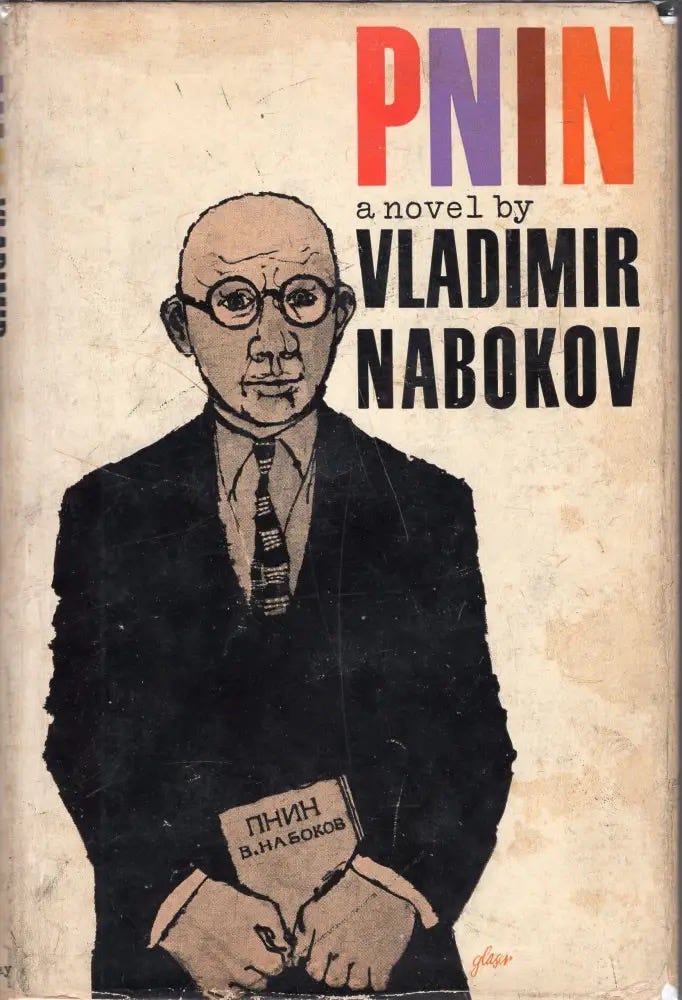
An unsurprising first entry. To me, as to many others, Pnin is the capo dei capi of emigrant novels. There’s a cunning cruelty in its narration, combined with a profound empathy and the hazy beauty of memory Nabokov summoned at his most sentimental. It really is a masterpiece of both prose and construction, so I have little in the way of an endorsement that would live up to the novel, other than READ IT IF YOU HAVEN’T AND READ IT AGAIN IF YOU HAVE. But for our purposes, here’s what became the chapter that encapsulates our subject matter.
Because I am a Russian-speaker, I also get the smug pleasure of detecting the linguistic easter eggs in the winding prose of the book—I think often and fondly about the asides on drafts. If his Russian was music, his English was murder.
Night Roads by Gaito Gazdanov (1953)
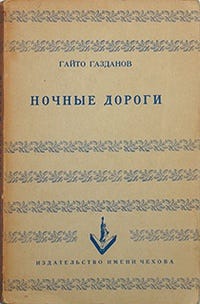
Readers of Gaito Gazdanov (Ossetian, from the Russian Empire) often compare him to Nabokov, I suspect, to encourage the broadening of what we think of as the white émigré canon. I find Gazdanov’s approach to be more libidinal and lacking in the narratorial calculations with which Nabokov’s writing is so generously seasoned. In that, it generates greater emotional force; it is also just more openly tragic and follows people far more disadvantaged than Nabokov’s genteel (anti-)heroes. Like the narrator of Night Roads, Gazdanov too worked as a taxi driver in Paris; it seems that this he found to be more valorous work than writing or editing, as it were. It is not a perfect book, but it was one of those reading experiences that split my life into two; before I had read it and after. Perhaps I was especially receptive to it when I read it (during an isolated period of being alone in Vienna), but I found the way that it portrays the unfolding of a life as if it had already been lived to its conclusion an absolutely breathtaking way to render time. If you’re desirous of a primer on Gazdanov, Sophie Pinkham wrote a really good essay about him for the LRB.
Zoo, or Letters Not About Love by Victor Shklovsky (1923)
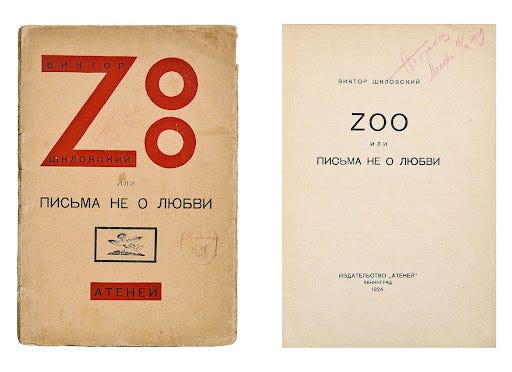
For some reason, during the early days of Russia’s full-scale invasion, I felt inexplicably drawn to this novel. It might have been that with the mass departures of people of my age and political creed from Russia, as they made their way across borders on foot, there was a general sense of misplaced romantic abandon in these circles, many fancying themselves White Russians in exile, as they settled in Tbilisi, Istanbul, or, indeed, Berlin. Or it might have been that I was lovesick but was forced to think about other things, like war. It’s hard to know now, but nevertheless it’s amazing how, in the right hands, avoidance and denial take on a generative power, such as to negate themselves. If you’ve heard about the book, you’ll likely know that it came from the writer Elsa Triolet, the object of the literary theorist’s Victor Shklovsky’s unrequited love, asking him to no longer write to her about his suffocating love (“You gave me two assignments. 1.) Not to call you 2.) Not to see you. So now I’m a busy man,” he wrote to her). This resulted in this formal experiment, an epistolary novel, which is not typically a genre I like, consisting of affectionate, intimate letters about anything but love—a portrait of literary émigré life in Berlin shortly after the revolution, both exterior and interior.
Call it Sleep by Henry Roth (1934)
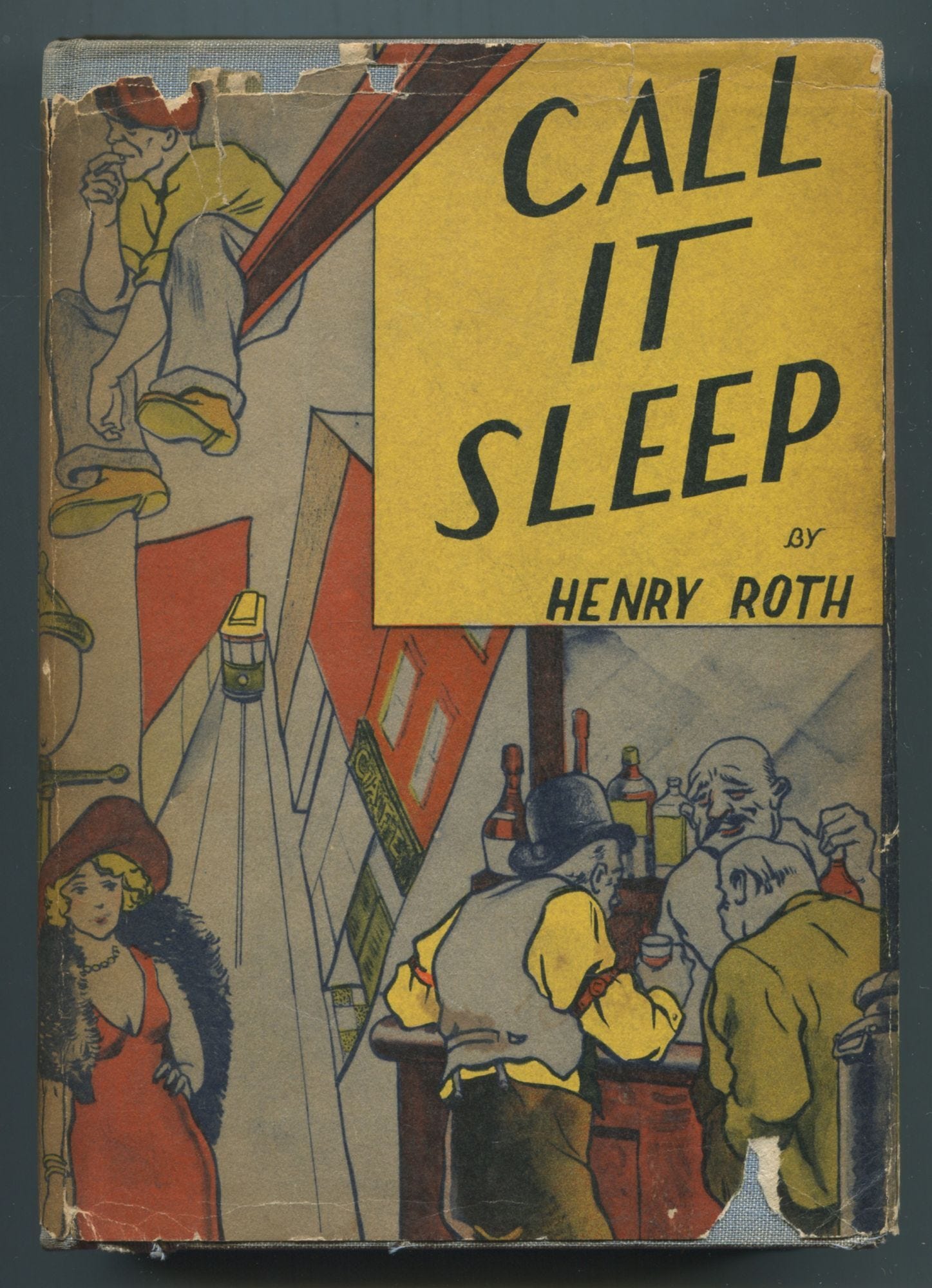
An iffy inclusion here, because if I was to abide by my own categorizations this would, of course, be an immigrant novel, but I’d say that the parental thread here is intriguing if one were to regard it through the prism of leaving rather than arriving. It’s also just a beautiful piece of literary modernism, narrated by a six-year-old child—the son of Galician Jews who are recent arrivals in the tenements of the Lower East Side—and culminates in an incredible polyglot polyphony. If you won’t take my word for it, perhaps Alfred Kazin’s might do the trick?
Sleepless Nights by Elizabeth Hardwick (1979)
It might be that I am simply obsessed with this book, but I think reading it as an emigrant novel is an intriguing way to engage with an opaque text like this; it does, after all, portray a life in New York, haunted by previous or concurrent lives in other places. The Billy Holliday parts? And if not that, the bits about the concentration camp survivor in Amsterdam—a man with a lot of joie de vivre—his French wife, and his lover.
My Life in CIA by Harry Mathews (2005)
I was resistant to including a book about and by an American in Paris, because that canon, formidable as it is, is populated by those whose eventual return to the United States always looms as an inevitability, which is decidedly a different thing from the kind of expatriatism we’re talking about here. But My Life in CIA is a very, very strange book that I’ll take any chance to recommend, and perhaps it fits here because one could say it’s about a commitment to both assimilate (Mathews, a close friend of Perec’s, was the only American member of Oulipo) and to accept how it is, after all, impossible to assimilate. It’d be vulgar to describe it as being about the absurdities of such a life, and frankly, I can’t be completely sure I fully understand it, but nevertheless I love the book and hope that you might too, especially if you’re in the mood for something set in Paris.
Mathews generally is an intriguing character to me, and his marriage to Niki de Saint Phalle is something I think about often, for no reason I can pinpoint.
Americanah by Chimamanda Ngozi Adichie (2013)
Not usually one for contemporary realist novels (just an aesthetic thing, I can’t mount a well-argued objection to the genre), this makes Americanah an unusual item in any list of mine. Admittedly, it is now a long time since I have read it, but I return to it in my mind over and over again—it’s surgical in its dissections of how cultural context shifts identity and rather virtuosically straddles the dichotomy of leaving/arriving.
Class by Francesco Pacifico (2014)
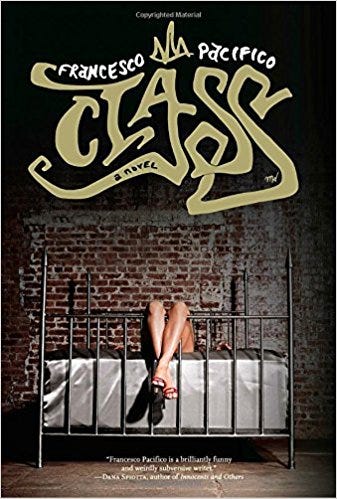
I was inspired to pick the novel up by Pacifico’s brilliant essay in n+1 from a few (shit, six) years ago, which chronicles the process of translating the novel, originally written in Italian, into English. Pacifico, also a translator, took on the task himself, and found himself not so much translating as editing the novel in profound ways—profound enough to warrant for the new version that came out of its translation into English to be translated back to Italian and republished. It’s far from a perfect novel with a few strange choices at its foundation and most certainly a bit of a time capsule, a clumsy one at times (its Romans-in-New-York refer to Williamsburg as Willy), but I still admire it for its resolute tackling of emigration by way of consumption and the nuances of class. Money might be the most difficult thing to write about.
The Europeans by Orlando Figes (2020)
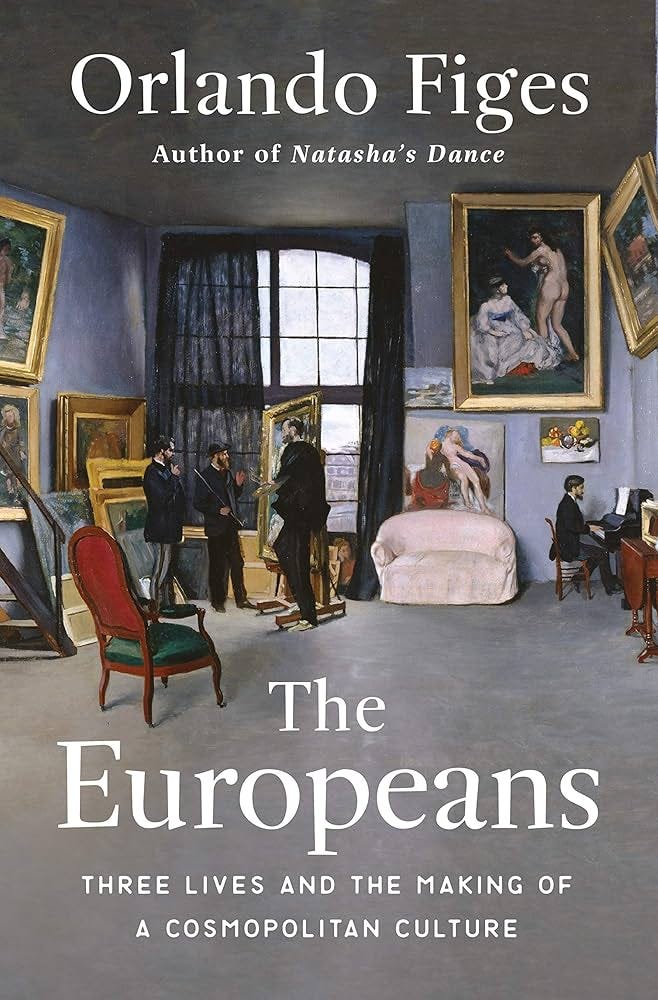
This is a really engrossing history of, well, exactly what it says on the tin, Western cosmopolitan culture, told through the love triangle between Ivan Turgenev, the singer Pauline Viardot, and her husband Louis. Turgenev (Tougeneff?) here appears as a cultural intermediary, swerving from French into English, into German as he proselytizes the exotic beauty of birch groves. Figes’s is a far more charitable portrayal than my own, abridged, glib one, and serves to chart the brief blooming and disappearance of a European ideal we still, I’d argue, are attached to. Perhaps, Natasha’s Dance (also wonderful book!) might be a more apt entry here, but I was very amused by the episodes of Turgenev and Dostoevsky’s bitchy underhanded little snipes at each other in Baden Baden, wherein the intellectual veil of the disagreement (really, Dostoevsky, an ardent gambler, owed Turgenev money) was a kind of clash between Westernizers, in the person of Turgenev, and Slavophiles, in the person of Dostoevsky.
But yes, I’m very interested in the tension between “promoting” and “peddling” culture... Something to be said about Pevear and Volokhonsky (whose translations, controversially, I like, but I maintain that this is because I speak Russian), but that’s for another time.
Diaghilev’s Empire by Rupert Christiansen (2022)
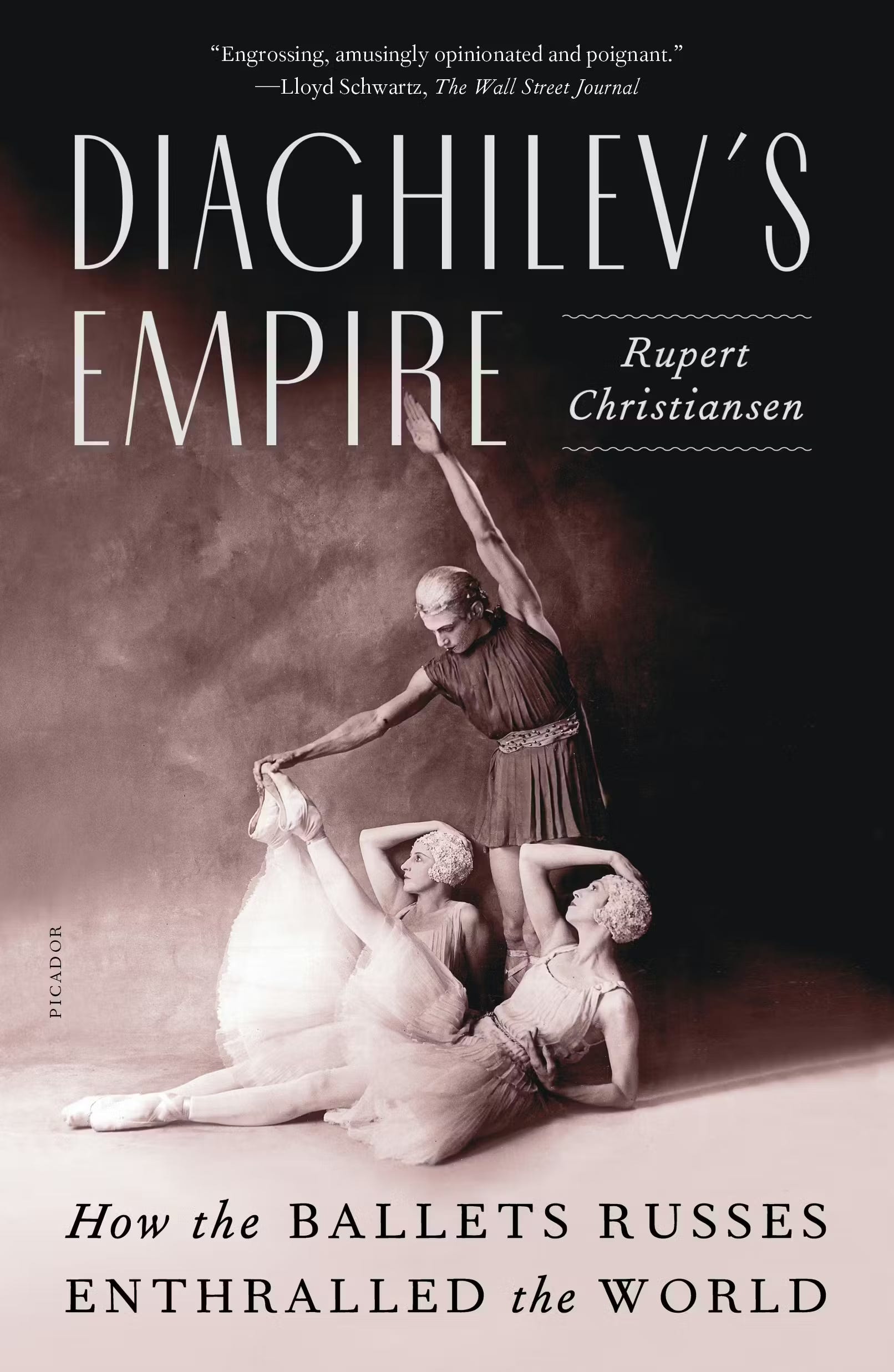
Speaking of cultural peddlers—this is a book about Diaghilev and his legacy, I read recently and was absolutely enthralled by the range of its portraiture, mostly of people who were far away from home, to find fame and fortune, or simply a better life. There’s ego, hubris, vanity, and exploitation, runaway ballerinas who end up found on Broadway, and virtuosic flamenco dancers who become obsessed with the metronome to the point of insanity. This could, of course, be read as a book about the history of ballet, which, I think, is how it was written, but this travelling circus of packaged culture is a more friction-laden companion piece to the trains, planes, and automobiles that took Figes’ Europeans across an as-yet-loosely-bordered World.
I’m sure there are gaping omissions in the list above, but I haven’t yet read Sebald’s The Emigrants, nor have I read much Dovlatov, whom it feels necessary to mention. Limonov, yes, but I am not a fan, despite being able to appreciate his brilliance, and It’s Me, Eddie is probably more a book of exile, as are these other honorable mentions.
Finally, I shall leave you with this feuilleton about tsarist Russian emigrants that flooded Europe post February 17 by Austrian journalist Joseph Roth, a friend of Stefan Zweig’s. I recently opened a collection of his dispatches from Russia, brilliantly translated into Russian by a group of ten translators. It felt serendipitous to be confronted with that essay just as I started thinking about writing this post, and so, I’ll say that it was the inspiration.
À bientôt, folks!
Delighted to see you mention Mathews, who I think is underdiscussed. Also a fan of Figes' book, Turgenev's Spring Torrents is a very good novel about the Russians' relationship to Europe.