
On writer's block
Or is it reader's block? Anyway, I'm trying not to be so precious.

This is an essay that has been in my drafts, in bits and pieces, since October. I wanted to finish it so I can move on to other things. More soon, but, for now, this.

The last thing I really managed to read were the uncollected essays (as well as reviews, Interviews, and letters to the editor) of Vladimir Nabokov, edited by Brian Boyd and Anastasia Tolstoy and rather unceremoniously titled Think, Write, Speak. It came into my possession as a trophy brought home from my boyfriend’s place of work; his boss, an artist known for stacking large painted rocks, was getting rid of it, and as the saying goes, one man’s trash is another man’s gift to his girlfriend. Sarcasm aside, that indeed it was, or is, as I am finding continuously: a gift. And I have thanked G. repeatedly for it.
I’ve been having trouble reading and, resultantly, writing; a spell brought on by an attempt to write an essay in conversation with Elizabeth Hardwick’s Sleepless Nights, which I had re-read recently in one gulp and found that it stirred me so this time, that there was simply nothing else that I could or should write towards other than the movement of Hardwick’s masterpiece. I got stuck a few hundred words in, when I decided to address the question of what the book is about, and more generally, the very question of aboutness—the persistent desire for everything to have a center from which it unspools. I presumed, wrongly, that Hardwick must have had “the good sense” not to answer the question; the Hardwick of my imagination spoke rarely and sparsely and only when she had something of great substance to say in a tightly packed sentence. I decided to verify if this was indeed the case, and rather quickly I came to find that Hardwick was subjected to answering this question on a number of occasions, and in a radio interview, which I’d realized had come to inform many an essay about her work, she tells the interviewer: it is a book about poor people. This disrupted my plan of writing about the subtle dislocations that make her prose so mesmerizing, because how could my essay be in conversation with Sleepless Nights, now, if it did not consider class its subject matter? There was going to be a section about the fanciful life story of an Iranian child refugee born not too long after the revolution, as told by the now-man himself, which could have offered an opportunity for a Hardwickian turn—it might yet, I should return to it—but before I could get to that I decided that in order to write the essay I must read all of Hardwick’s own essays, lest they illuminate something I would feel ashamed for missing, and in the end the Hardwick of my imagination, enriched and given new dimensions by the reading and the listening I had been doing, sat back with a smirk of disdain for the meager volume and, what’s more devastating, the poor quality of my reading. I became convinced that my mind was no longer capable of penetrating textual matter and all that lies beneath it.
Nabokov hasn’t quite undone this. In fact, the Nabokov of my imagination is a person of far less generous spirit than the Elizabeth Hardwick, and holds his reader, or readers in general, to standards so high that one might suspect that there is no satisfying them unless, of course, one is Lionel Trilling or Alfred Kazin, or effusively complimentary about Nabokov’s work, wit, and erudition. But there’s something very human about his brand of snobism, charming only in a man who is an aristocrat of a land-no-longer-existent; his Strong Opinions, in which he is steadfast throughout the decades (Dostoevsky is “a journalist,” Pasternak is a bad prose writer, Russian literature started with Pushkin, and so on), are one of few constants; the furniture in the only home he has—his imagination. It’s really not at all surprising that he spent the last sixteen years of his life living in a hotel in Switzerland, but interviewers kept asking him why.
But yes, what I found helpful in my “block” is to see a great mind, even if, at times, mostly filled with butterflies and verbal curlicues, relaxed. Nabokov’s uncollected essayistic prose is generally offhand, if not slapdash, especially when it is not literary criticism. The literary criticism tends towards the eviscerating; his aversion to Soviet writers, for instance, and anyone who wasn’t entirely in disagreement with the revolution is a principal stance, for which he creates aesthetic justifications, rooted in a general disdain for Soviet culture but also from deep reading, which definitionally births (or should birth) idiosyncratic interpretations. His chief complaint is the language, what Kornei Chukovsky would come to сoin as канцелярит (kantselyarít) — the bureaucratese adopted across all strata of life, including literature, stamp-like and endlessly reproduced in both syntax and morphology. In this, too, though, there is lament and pain for a language lost to reform and a new order, home and childhood along with it.
Anyway, I don’t really have a dog in any of these races (there is comparatively little Soviet writing I truly enjoy, and I’m not even going to pretend that I am qualified to argue with any of Nabokov’s literary opinions otherwise). Nabokov, too, seems to have withdrawn his: later in life he had a rule not to discuss his contemporaries publicly. Perhaps this was because he would consider this punching down, but I suspect that, as every master, he knew his limitations, and analyses of the present were not his strength. Behold this absolutely godawful take from 1929, proven immediately wrong by history:
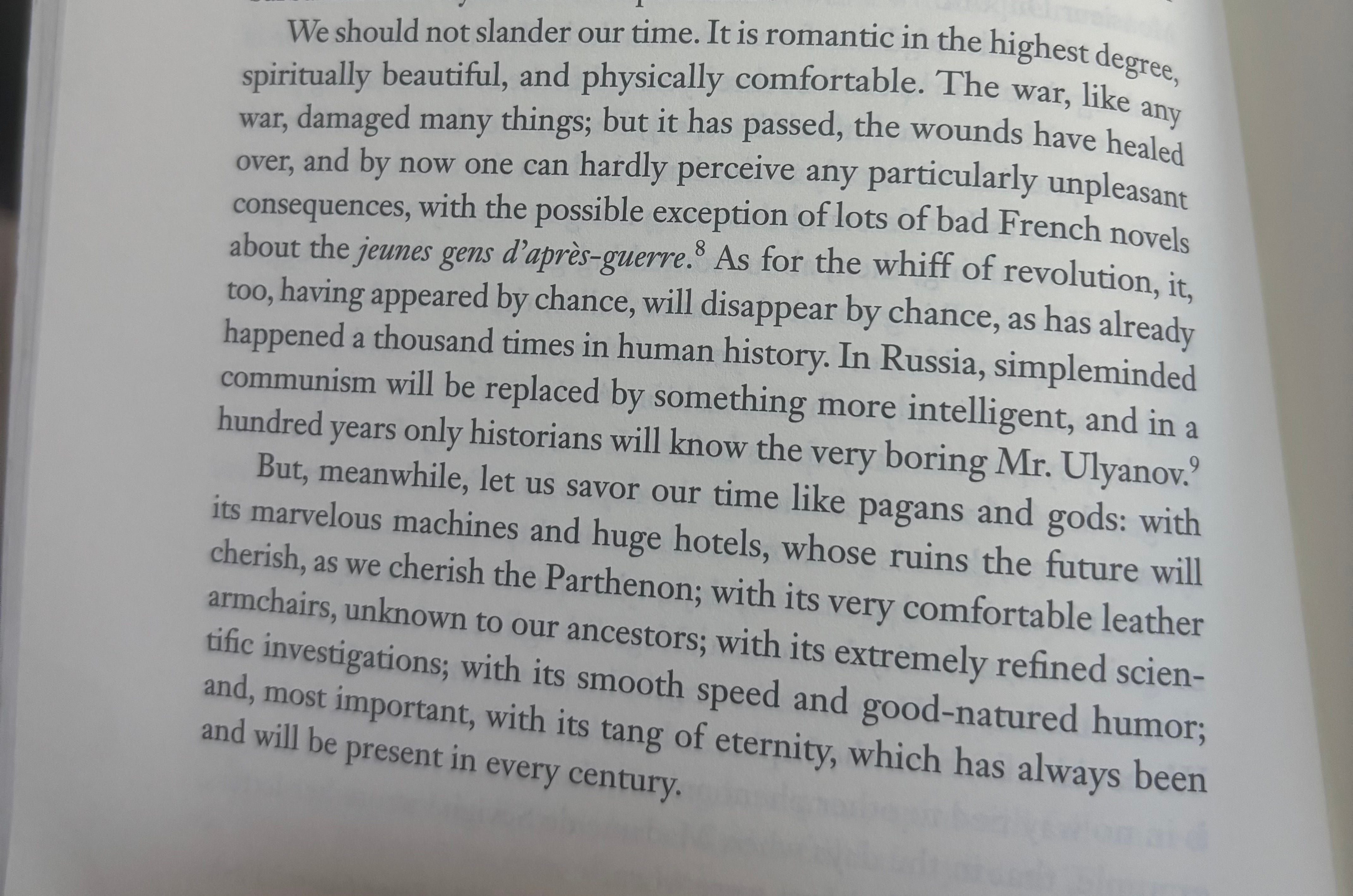
That said, this is from an essay about his hatred of generalizations, which, in its principle, I found instructive; an oblique explanation in how one arrives at a virtuosic selection adjectives which is something Nabokov and Hardwick, actually, have in common—an ability to shuffle around meaning and image causing captivating displacements of language that produce a precision of strange sharpness; an allergy to cliché. This was an allergy of which Nabokov warned his interviewers and, were they not to listen, his responses would turn up curt and churlish.
My own mind rarely relaxes anymore and it’s not because it is being stretched in interesting, unknown directions, but rather the opposite—a feeling of short-circuiting, of static on the television screen. Abrupt, tense, noisy. I suspect that my being drawn to short forms and the churnings out of publicity campaigns of yore in my reading might have something to do with what fills this mind of mine: my job, which happens to be the very publicity the churnings out of which my colleagues and I struggle to produce lately. For now, I’ll avoid talking about the intricacies of my daily labors on behalf of arts organizations and institutions of various stripes, but I’ll just say that when things are difficult for journalists, they are also difficult for the publicists, and, at times, things have been feeling untenable. The best advice I can give anyone desirous of “coverage” is either to cynically ride the waves of the news cycle, to throw a party and be generous with it, or to stop hiring publicists and befriend writers and editors themselves; there are only so many favors we can call in.
I feel like something has atrophied in me, too, due to the incessant use of cliché both the efficiency and humility requisite to a publicist ask of me: you want to communicate things fast, concisely, and like you do not believe you might do a better job of writing about it than the journalist I am pitching so that they can pitch their editor. And so, one would think that with all of the “reaching out” I do, my arms would have fallen out of their shoulder sockets by now. Not so unreasonable would be the anxiety that all of the planes that have recently fallen out of the sky have something to do with the signal interference caused by “putting the following” on the “radars” of editors. I should be all out of dopamine—and I probably am—the amount of “excitement” I dole out when I let clients know that this or that round-up is “now live.” I sometimes get dizzy from frequent “circling back on the above,” and the amount of “just checking in,” I do, one might think I live at a hotel.
I could go on, but this bit (hardly even that) wears itself out quickly and plenty has been written, with greater dexterity and brilliance, about these mutations of language, the jargon that makes its way into everyday parlance as we bring it home from the office, so pervasive that we no longer recognize it as the litter that it is (Molly Young’s excellent essay on “Garbage Language” comes to mind—things have gotten even worse since then). I find humor in the fact that in 2025, my complaint is essentially the same as that of the aforementioned Kornei Chukovsky, or Nora Gal, a Soviet translator and theorist of translation, who, too, adopted Chukovsky’s critiques in her The Word, Alive and Dead (Cлово Живое и Мертвое) of the bureaucratic permutations of language birthed by the Revolution and applied them to “this little art” that she herself practiced. It is this treatise that I went on to read after the bits and pieces of Nabokov, but could not sustain it for very long; the “something that has atrophied in me” is my attention span.
It’s been months since I began this attempt at writing, and I haven’t written since. I was going to recount how, determined to break the non-reading spell, I marched, one evening, into McNally Jackson and got a copy of Maeve Brennan’s collected Long Winded Lady columns that she had been writing for the New Yorker starting from the 50s through to the beginning of the 80s; how I had read some of them throughout my years as a subscriber to the magazine, in the online archives, and like pretty much anyone else who has ever read these dispatches found them completely delightful in their awkward minuteness that captured the life of the city like a textbook diagram depicting blood cells moving through a body; how I would always have the book in my bag and read it any time I was on the subway, in sustained amusement from these narrations of human incoherence and urban coexistence by someone who presents herself as a dowdy middle aged woman, but writes with the cold ease afforded to someone who was, in reality (forgive me, Maeve) a smokeshow.
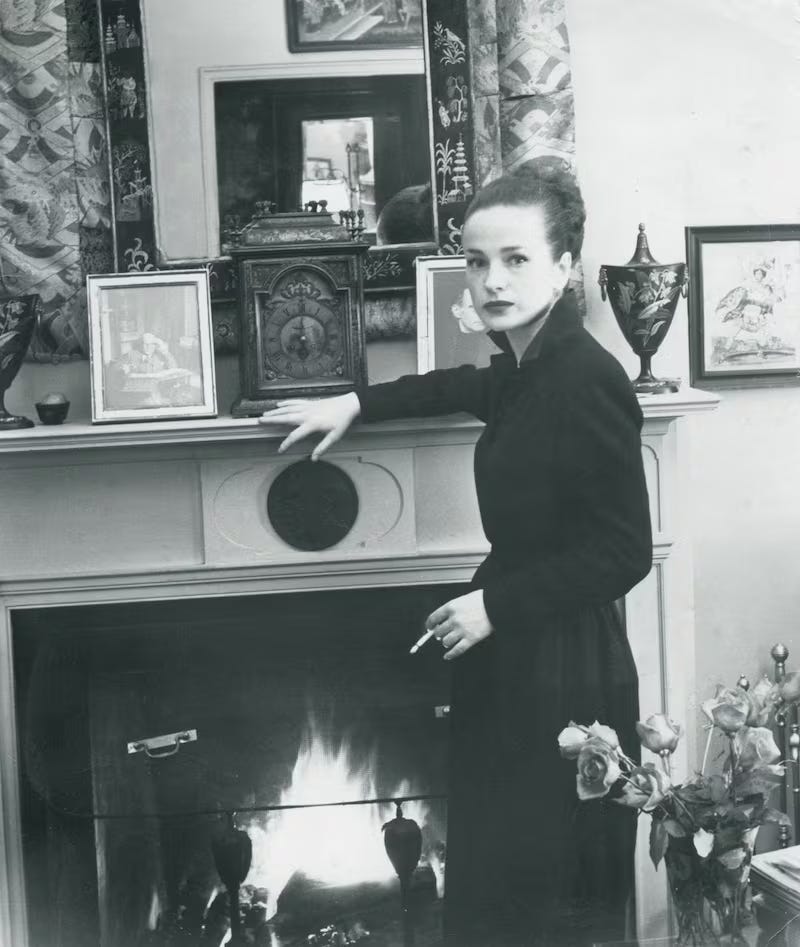
While its ease may be cold, in dealing with strangers and framing these tableaux of their lives, the writing takes on an essential warmth: the assumed generosity of a waiter who does not draw attention to the fact that the narrator’s broccoli remained uneaten because of her confusion as to how to tackle the florets with her mouth; the regard for the intelligence and keen observation she imbues a fellow subway rider with in the worry that he might think her a fool when she stands up a stop too early and sits back down only to stand up again at the next stop.
It made me think about all of the times the city presented me with its self-contained scenes, in some of which I too sometimes played a role, even if not always sure what it was. I catalogue them in my mind, and when I remember that this is something I do, moving through New York becomes an exercise in curiosity. There was the night when, walking to a bar in Chinatown, the group I was with stumbled upon a movie set, a wet strip gleaming with engineered puddles reflecting non-existent neon lights on a night of unseasonably warm air and clear skies. We entered the bar and promptly forgot about the movie set, until a few hours later, we were outside talking and smoking cigarettes, and a man with a walkie talkie and cargo pants came to pick up and carry away the mailbox we had mindlessly arranged ourselves around. He did this in such matter-of-fact fashion, that, for a second, it felt like the whole street was subject to imminent, slow disassembly, but nothing much had changed: the neon reflections were gone and the puddles now just looked like the product of a zealous hosing down.
Another night, after watching a friend exert himself in acrobatic fits of physicality on the stage of his play, dinner at the Ukrainian National Home in the East Village, one of few places in lower Manhattan where one can get a table for ten with no reservation; as we sat sipping on horseradish vodka and picking combo plates of blintzes and potato pancakes, we noticed people of peculiarly sleek dress and demeanor make their way through the dining room and disappearing into the adjoining room, reserved for events and convenings. After a while of observing these comings of people flocking to the room like fireflies to the marshes, our table became curious about what was happening: faint music could be heard, but no toasts, or glass-clanking, or conversation. As we were leaving, we decided to peek in: gliding about the floor, cleared from chairs and tables, were these sleek men and women of differing ages—the men tending towards the older, the women towards the younger—in a tango. Mesmerizing, in the fluidity of their movement, like swans on a lake, we left them there.
Or the evening I stood in an alley, a few years ago, across from a gallery, waiting for G. to go to its opening, a man in utilitarian dress rolled up a worn small grey suitcase and sat down on it at a respectful distance from me. I stood, alternating between looking at my phone and the gallery entrance, aware of the man’s awareness of me. “Do you mind if I do this here?” he asked politely, motioning at the rubber band pinched between his fingers. I told him to do what he needed to do, and he proceeded to tie off.
A young man disassembling bundles of flowers to make an exquisite firework-like arrangement in a Trader Joe’s bag, schears et al, on the subway; a tiny Papillon labelled “SERVICE DOG” in a font bigger than its nose sitting, obediently, upright; a man writing in his notes app in Russian an account of the difficulties of immigration in the form of a marketing case study; “Did you see the press conference yesterday?” the bodega man asks me as I pay for my Gatorade the day after Zohran went to the White House. “You’re always in a hurry,” he tells me another time.
The Brennan columns didn’t quite lift the block, but they reached through the anhedonia I was feeling in looking at or watching anything. I couldn’t tell if I just didn’t like anything, or if I was just adjusting to my meds which flattened everything a bit, or if the meds weren’t working at all. One evening, as I was on my way to see my friend Hannah, I opened the book at a dispatch titled Sixth Avenue Shows It’s True Self:
“I have been searching for something good to say about Sixth Avenue, but I have failed in my search. Sixth Avenue shows its true self only during the two hours after dawn, when it is almost empty of life. During those hours, in the silence and the nice clean light, the eerie unsubstantial disorderliness of those blocks of structures becomes apparent and anyone walking alone through that ugliness can see without any trouble that Sixth is not a human thoroughfare at all but only a propped-up imitation of a thoroughfare, and that its purpose is not to safe or pleasant passage for the people of the city but to propitiate, even if it is only for a little while, whatever the force is that feeds on the expectation of chaos.”
As I read these lines, the very Hannah I was on my way to see quietly sat down next to me, the sneaky joy of her expectation forcing me to look up. Surprised and happy to see her, excited by the aptness of this encounter, I made her read the same lines, and set off on how I have been haunted by what I called “the cursed corners of Sixth Avenue” for a while now. The summer I had moved away from my apartment on Minetta Lane, there was a murder by the Papaya Dog which is no longer there; I had witnessed a man whip out a thick metal chain from the helmet case on his scooter and threaten another man on a scooter with it; I saw a gurney with the outlines of a body under a white sheet on it being carted into the funeral home. But these are all stories for another time; or, really, that is all there is to them, and they’re exactly where they belong.